
The Clean Cooking and PURE Sectors Don't Have a Funding Gap.
They have a Systems Gap. A look at what's really holding back clean cooking and productive use of energy, and what it takes to fix it.
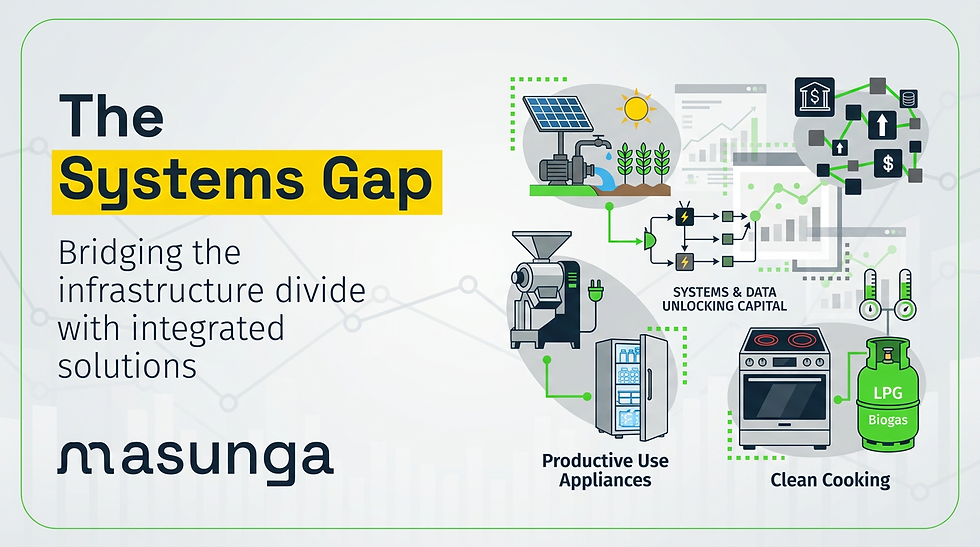
There is a comfortable narrative in the clean energy access sector: that the primary constraint is capital. That if we could just mobilise enough funding, deploy enough blended finance instruments, and persuade enough institutional investors, access to clean cooking and productive use of energy (PURE) would scale at the pace the moment demands.
The evidence tells a different story.
In Kenya alone, nearly USD 1 billion was mobilised for green energy in 2025, driven primarily by two landmark transactions: the D.light BLK 2 securitisation (USD 604 million) and the Sun King capital raise (USD 156 million). Over the 2021–2025 period as a whole, an estimated USD 2 billion flowed through the sector. Bilateral DFIs, multilateral institutions, impact investors, commercial banks, and MFIs are all increasingly active. The IFC, AfDB, Shell Foundation, FMO, and BII are part of the roster of capital providers, which is long and growing.
And yet, clean cooking adoption in Kenya sits at just 31.6% nationally. In rural areas, that figure drops to 11.4%. More than 6.7 million households still rely on traditional biomass. PURE markets, solar irrigation, cold storage, and agro-processing remain structurally underfinanced relative to their economic potential.
So if capital is increasingly available, why isn't it reaching the companies and communities that need it?
The answer, according to a recent assessment of local financial institutions commissioned by Power Up Kenya, lies not in the volume of capital but in a set of structural constraints, chief among them a systems gap that makes operators invisible to the very investors willing to fund them.

The Real Constraints
The report identifies several interlocking barriers, but they share a common root: operators cannot effectively demonstrate their value.
Data invisibility is the most damaging constraint. Clean cooking and PURE investments are routinely bundled under broad "green finance" or "climate finance" categories. The IEA has noted that clean cooking investment is "invisible" within aggregated energy-access data, causing underestimation of actual capital needs. ESMAP confirms that bundled financing in the energy sector masks subsector-specific cashflow patterns and risks. The World Bank's tracking of SDG 7 finance flows fails to differentiate between clean cooking sub-technologies, e.g. LPG, electric cooking, ethanol or PURE applications such as irrigation and milling. SEforAll has further shown that aggregated energy-access investments disproportionately favour electrification while underfunding clean cooking and productive use sectors.
When operators cannot be seen, they cannot be evaluated. When they cannot be evaluated, capital is mispriced or withheld entirely. The PowerUp Kenya report confirms this directly: lack of subsector visibility results in chronic underfunding.
Weak operational systems compound the problem. Many SMEs in the sector operate without the financial infrastructure needed to produce decision-grade data: clear unit economics, verified repayment histories, transparent portfolio performance. Local financial institutions cite limited credit histories, informal operations, and the absence of auditable asset-performance data as primary reasons for declining or over-pricing loans to otherwise viable businesses. The financing gap created by these barriers is estimated to exceed USD 4 billion for clean cooking and USD 100 billion for PURE across Africa.
Misaligned financial products follow directly from the above. Without subsector visibility, lenders reach for generic instruments: short-tenor, collateral-heavy loans designed for businesses that look nothing like a last-mile PURE distributor or a clean cooking SME. Local-currency loans in Africa commonly carry interest rates of 15–22% with short maturities, while PURE assets typically require payback periods of 3–7 years. Collateral requirements designed for fixed-asset businesses penalise asset-light PAYGo distributors whose primary assets, LPG cylinders, PAYGo meters, biomass stoves, are not accepted by banks.
Risk allocation, not risk level, is the binding constraint. The sector's constraint has shifted from affordability to risk allocation, a diagnosis echoed by UNDP, the EIB, and voices across the recent ARE Energy Access Investment Forum in Nairobi. Capital providers understand the thesis. What they lack is the data infrastructure to underwrite it with confidence.
What Happens When the Systems Gap Is Closed
The report's case studies are instructive. They are not stories of new capital being created, rather they are stories of existing capital being unlocked because operators could finally demonstrate their performance.
Sun King's receivables securitisation, the landmark 2023–2025 transaction series that mobilised a cumulative USD 286 million through Kenyan commercial banks, including Absa, KCB, Co-operative Bank, and Stanbic, succeeded because PAYGo customer repayments could be structured into transparent, auditable cashflows. The securitisation SPV isolated the asset, structured credit enhancements, and provided the data visibility and risk-adjusted clarity that local banks required. The capital was always there. What changed was the ability to see the asset.
BURN Manufacturing's success in attracting capital from the European Investment Bank (USD 15 million in 2024), the Trade and Development Bank Group (USD 80 million in 2025), and carbon finance facilities followed from its ability to demonstrate manufacturing performance, distribution scale, and verifiable emissions reductions. Investors did not create demand for BURN's product; BURN created the operational credibility that made it fundable.
The CASEE programme, through which Shell Foundation and FCDO enabled Co-operative Bank to unlock approximately KSh 2.8 billion for smallholder productive use assets, worked because the programme de-risked the bank's ability to see the sector clearly, reducing its lending rate from 14% to 8% and unlocking an estimated 10x return on its balance sheet through approximately 328,000 farmer loans.
In each case, the mechanism is the same: better data visibility converts perceived risk into deployable capital.
The Masunga Thesis
This is precisely the gap that Masunga, through our software platform PaygOps and our receivables financing platform Bridgin, is built to close.
PaygOps gives PAYG and off-grid energy distributors the operational infrastructure to run their businesses with the rigour that investors and lenders require: clean portfolio data, real-time repayment tracking, standardised reporting, and the unit economics visibility that banks need to underwrite. It converts operational data from a liability into a financing asset.

Bridgin takes that operational data and structures it into aggregated, ring-fenced receivables pools, creating the standardised, repeatable financing pathway that allows smaller operators to access capital at scale. The same logic that made Sun King's securitisation possible applied to the broader distributor ecosystem.

Together, they address the core diagnosis the PowerUp Kenya report reaches: that clean cooking and PURE remain structurally underfinanced not because capital is absent, but because the data infrastructure needed to direct it has been missing.
The report's own recommendations land in exactly this space: improved data transparency, stronger enterprise pipelines, and better sector tagging within green-finance systems. These are not abstract advocacy goals. There are operational problems with operational solutions.
What This Means for Investors and Programme Designers
For DFIs, impact investors, and results-based finance programme designers, the implication is direct: the most leveraged intervention is not more capital at the top of the stack, it is better operational infrastructure at the enterprise level.
Operators with clean data attract capital faster, access better terms, and unlock RBF mechanisms that depend on verifiable performance. The investment in systems pays a multiplier return on the capital deployed alongside it.
Kenya's national energy targets require USD 1.14 billion for universal clean cooking by 2030 and USD 1.94 billion for broader distributed renewable energy, PURE, and energy efficiency goals. With four years remaining, the pace of capital deployment will be determined not by the willingness of investors but by the readiness of operators to receive it.
The funding gap is closing. The systems gap is what remains
Bridgin and PaygOps are Masunga products

If a game seems difficult at first, focus on one mechanic instead of mastering everything immediately. Unblocked Games on CoolGamesFree can become more approachable when you practice movement, timing, or resource management separately before combining those skills.