
Masunga 2025 Year in Review — Accelerating Access Through Data, AI & Capital Innovation

2025 was a defining year for our organisation. What began as Solaris Offgrid a decade ago evolved into Masunga — a name inspired by a small business owner who transformed his livelihood using our technology and improved dozens of lives supported by his business. His story reflects the core of our mission: that behind every data point, there are real people whose lives can be improved through better tools, stronger systems, and access to credit.
This mission remains urgent. Across emerging markets, access to clean cooking alone still requires USD 8 billion per year in investment (IEA), while global climate-finance needs continue to exceed USD 1.5 trillion (Climate Policy Initiative). At the last mile, microlenders — critical to expanding energy access, agriculture, e-mobility and financial inclusion — still face constraints, including fragmented data, limited liquidity and inefficiency in manual processes, putting them out of reach for most investors.
Our 2025 efforts were dedicated to tackling these barriers.
Through PaygOps AI and configurability improvements and Bridgin’s progress on interoperability and standardisation, we strengthened the operating, data, and financing infrastructure to unlock capital and allow organisations to scale sustainably and operate with greater efficiency to meet the market demand.
This year, our combined platforms helped our partners reach 7 million people in more than 40 countries — our largest impact footprint to date.
AI & Automation: More Efficiency, Less Complexity
In 2025, PaygOps put stronger emphasis on AI-empowered automation, configurability, and interoperability, launching AI-driven tools designed to simplify operations and reduce manual work: AI-generated Custom Forms & AI chatbot tools for increased efficiency and user satisfaction, and the New Task System, improving planning, delegation, and field execution.
These innovations speak to a long-term goal: to help last-mile providers do more with less, and reduce operational friction and dependence on technical teams.
Key Success Stories From the Field
Customer success was central to PaygOps’ work this year, with some of our partners achieving powerful results:
Product Pick Up Process Improvement
“Our new Custom User Journeys feature resolves the identified bottleneck by transforming the process into a streamlined, step-by-step interface, resulting in a 57% reduction in product pick-up process time.” (See Full Case Study)
Powered a Scalable Layaway Model, supported by AI-ready workflows.
“Our agents turn ‘Little by Little’ into life-changing harvests. With PaygOps, they now have the tools to do it faster, smarter, and at scale.” Edgar Ayenda — Head of Field Operations, Shamba Kijiji (Read More)
Premier Program Proven Success for Scaling Complex Operations
“The Premier Program has fast-tracked our thinking about our model with a technology lens. Likewise, it freed up a lot of resources and time within our organisation.” Bianca Lima-Boekhoud — Corporate Development Officer at ForAfrika (See Success Story)
These stories show how improved workflows, real-time data, and flexible tools translate into concrete operational gains.
Lowering Adoption Barriers: PaygOps Goes Open Source + Fairer Premium Plan Pricing
Recently, PaygOps took two major steps to reduce the structural barriers that prevent last-mile organisations from scaling efficiently:
PaygOps Community Edition (open source): organisations can now deploy a self-hosted, open and free version of our platform, ensuring data ownership and enabling developers to adapt the system to their needs. This addresses one of the sector’s biggest bottlenecks: costly, rigid systems that limit adoption and prevent interoperability across products and markets. We will choose a group of first testers by the end of this week. You can still apply for Early Access HERE.
New Affordable and Scale-Friendly Premium Plan: organisations pay less per customer as their portfolio grows (up to 60% cheaper at scale), thanks to flat usage fees and volume discounts, ensuring operational costs don’t grow faster than impact!
Unlocking Receivables as a Climate Asset Class
While digital tools reduce operational friction, access to capital remains one of the biggest constraints for organisations delivering essential services. Fragmented data, high due diligence costs, and small, complex portfolios continue to limit investor participation—slowing the flow of capital where it is most needed.
In 2025, Bridgin continued laying the groundwork to close this gap:
Receivables-Financing Facility in Mozambique, led by Mirova UK and Hypoport Africa, where Bridgin’s data and back-up servicing infrastructure play a central role. This initiative contributes to a broader effort to position receivables as an investable climate-resilience asset class, enabling capital to reach organisations delivering essential services in underserved communities.
Joined the Investment Catalyst Facility Programme by GDC: as investment partners, Bridgin will help design and test risk-mitigating and innovative financing models, as well as collaborate on due diligence and monitoring, to improve access to finance.
Established a Special Purpose Vehicle (SPV) Model for securitisation-as-a-service: Bridgin's infrastructure includes reusable legal frameworks to provide legal separation between originators and a ring-fenced SPV, separating asset risk from company risk.
Strengthening investor-grade data and monitoring, through automated data flows, reconciliation, and portfolio analytics, addressing a core sector challenge: providing reliable, standardised information to assess performance, risk, and impact..
The continued growth of Bridgin’s pipeline reflects a recognition that capital must become more flexible and inclusive if the sector is to close the climate and development gaps. Discussions with organisations such as SunCulture and other sector players reflect sustained investor interest in data-driven, off-balance-sheet financing models. Across conversations with investors and microlenders, a consistent signal emerged: the need for standardised data, robust monitoring, and legally sound structures to reach smaller, more complex originators is widely recognised.
Bridgin’s progress this year reinforces a simple truth—impact depends on liquidity, and improving capital flow remains one of Masunga’s most critical contributions to the ecosystem.
Strengthening Relationships on the Ground
PaygOps team visited partners such as ForAfrika or Sizanani, supporting the onboarding and working side-by-side with field teams to optimise deployment and user journeys. These interactions remain one of the most important ways for us to align product improvements with real in-field needs.
We didn’t miss some of the key industry appointments, including the Africa Tech Summit, NY Climate Week, ADA’s SAM Conference, and other insightful events that bring together innovators, investors and practitioners. Across industry conversations—from Sankalp Africa to Acumen Summit, GOGLA’s Annual Meeting, or ARE Energy Access Investment Forum—Bridgin’s message resonated clearly: climate and livelihoods solutions will not scale without financial aggregation, standardised data, and tech support. (see Bridgin 2025 Field Learnings)
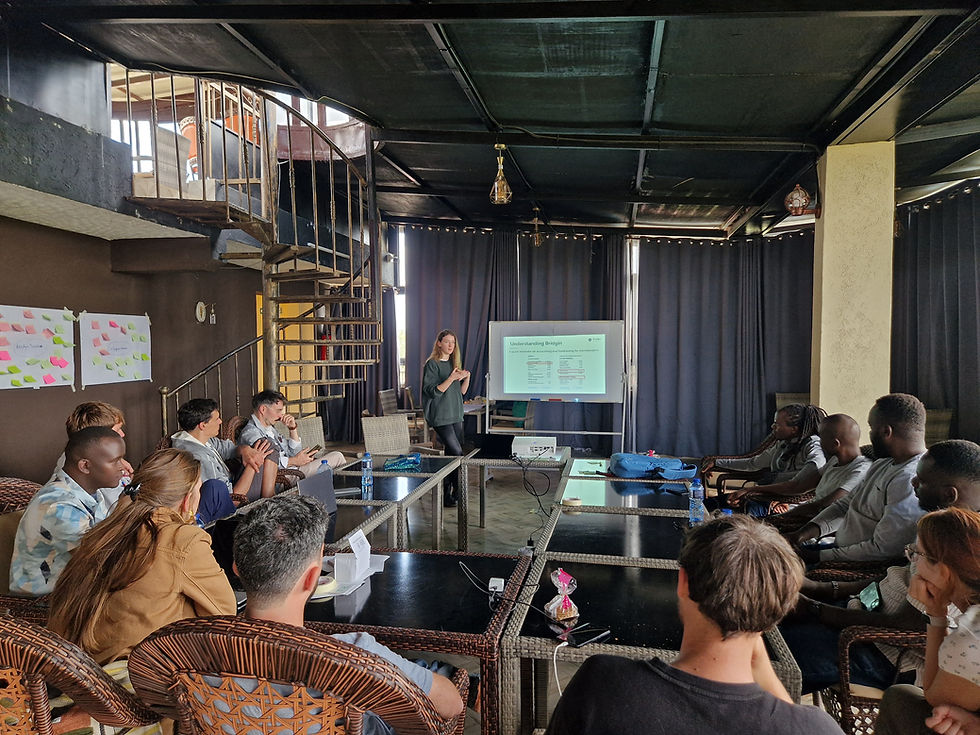
Team Gathering in Nairobi
One of our year highlights was our full-team gathering in Nairobi, Kenya, where colleagues from multiple countries came together to reflect, plan and strengthen collaboration. As in previous years, this gathering reinforced that our work is built on people—those we serve, and those who make our mission possible every day.
Looking Ahead to 2026: Scaling Trust, Efficiency & Capital Flow
As we move into 2026, our focus remains clear:
Strengthen the digital and financial infrastructure that enables microlenders to operate efficiently and access the capital they need to grow.
Advance data standardisation, automation and AI-powered tools across PaygOps and Bridgin, improving interoperability and reducing operational friction
Lower adoption barriers through open, flexible systems, including the expansion of PaygOps Community Edition.
The goal for 2026 is simple but ambitious: to reduce the technical and financial barriers that limit access to essential services, and to help our partners scale impact faster, more affordably, and with greater resilience.


Comments